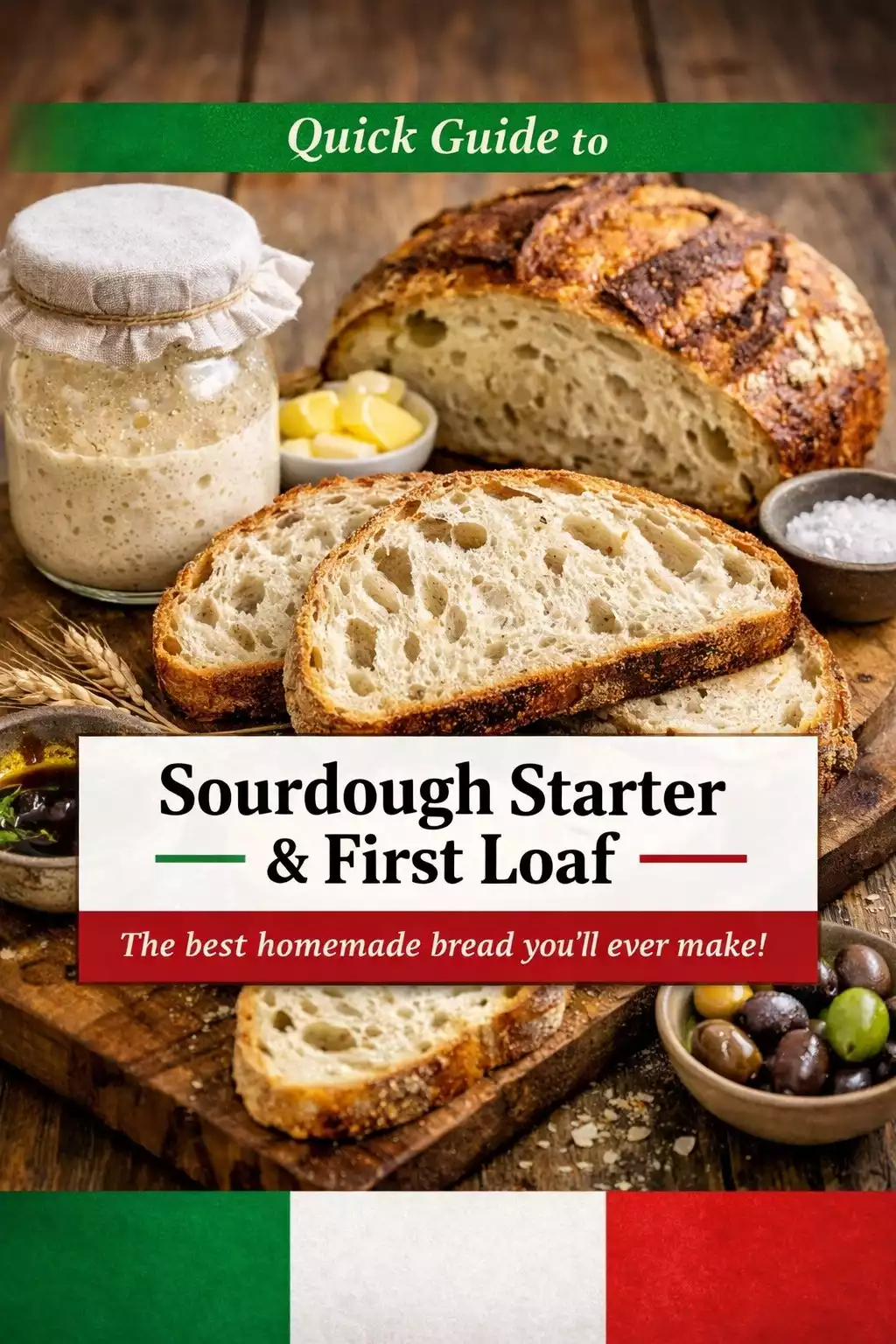
If you’re using jarred sauce for this, we need to talk. Sourdough Starter & First Loaf — the gateway to a baking practice that will change how you think about bread for the rest of your life. Sourdough is not a trend. My grandmother’s starter was older than she was, passed down like a family heirloom, fed with the seriousness of a living thing because that’s exactly what it is. A healthy sourdough starter is a community of wild yeast and bacteria that produces bread with a complexity, depth, and nutritional profile that commercial yeast bread simply cannot match.
Building a starter takes about 5–7 days. Baking your first loaf adds another 24 hours. It’s a commitment. But the starter you create will last indefinitely with basic maintenance, and the bread you bake from it will be the best you’ve ever made at home. This guide builds the starter from scratch and walks through the first loaf without cutting corners.
Once your starter is active, the bread world opens up. Pair this with No-Knead Artisan Bread for a same-day option, explore Homemade Pizza Dough for fermented pizza applications, and develop the full bread baking skill set with Soft Dinner Rolls, Buttermilk Biscuits, and Cast Iron Cornbread.
Why Sourdough Works
- Wild fermentation: Wild yeast and lactobacillus bacteria produce CO2 (for rise) and lactic/acetic acids (for flavor and preservation) that commercial yeast alone cannot replicate.
- Autolyse: Resting flour and water before adding starter allows the flour to fully hydrate and gluten to pre-develop, making the dough more extensible and easier to work.
- Stretch and fold instead of kneading: A series of stretch-and-fold cycles during bulk fermentation develops gluten without degassing the dough.
- Cold retard: Shaping and refrigerating overnight slows fermentation, extends complexity, and produces a dough that’s easier to score and load into the oven.
- Dutch oven baking: Same principle as no-knead bread — trapped steam allows maximum oven spring before the crust sets.
Part 1: Building the Starter (Days 1–7)
Starter Ingredients
- Unbleached all-purpose flour (or 50/50 with whole wheat)
- Room-temperature unchlorinated water (filtered or left overnight to off-gas chlorine)
- A clean glass jar, 1-quart or larger
Part 2: The First Loaf
Sourdough Loaf
- 450g (3¾ cups) bread flour
- 325g (1½ cups) water, room temperature
- 100g (½ cup) active, bubbly sourdough starter (fed 4–8 hours ago)
- 9g (1½ tsp) kosher salt
Instructions: Building the Starter
Days 1–2
Day 1: Combine 50g flour and 50g water in a clean jar. Stir vigorously to incorporate air. Cover loosely (not airtight) and leave at room temperature. Day 2: Discard all but 50g of the starter. Feed with 50g flour and 50g water. Stir well. Cover loosely. Don’t be alarmed if nothing visible happens yet.
Days 3–5
Continue twice-daily feedings: discard all but 50g, feed with 50g flour and 50g water. By Day 3–4, bubbles should begin appearing and the starter should smell slightly sour or fruity. By Day 5, the starter should be doubling in size between feedings. If it rises and falls between feedings with an active, bubbly texture, it’s ready to bake with.
Float Test
Drop a small spoonful of starter into a glass of water. If it floats, it’s ready. This indicates sufficient CO2 production to leaven bread. A starter that sinks isn’t ready yet.
Instructions: The First Loaf
Step 1: Autolyse
Combine bread flour and water in a large bowl. Mix until no dry flour remains. Cover and rest 30–60 minutes. This rest allows the flour to fully absorb the water and begins gluten development without effort.
Step 2: Add Starter and Salt
Add active starter and salt to the autolysed dough. Squeeze and fold the dough until fully incorporated — about 3–5 minutes of vigorous folding. The dough will feel slack and sticky; this is normal.
Step 3: Bulk Fermentation with Stretch and Fold
Cover and let sit at room temperature 4–5 hours. During the first 2 hours, perform stretch-and-fold sets every 30 minutes: wet your hand, grab one edge of the dough, stretch it up and fold it over. Rotate and repeat four times per set. Four sets total. By the end of bulk fermentation, the dough should have grown 50–75%, feel airy, and show bubbles on the surface and sides.
Step 4: Shape
Turn dough onto a lightly floured surface. Shape into a tight round by folding the edges underneath and rotating the ball against the work surface to build tension. Place seam-side up in a floured proofing basket (banneton) or a bowl lined with a heavily floured kitchen towel.
Step 5: Cold Retard
Cover tightly and refrigerate 8–16 hours (overnight). The cold fermentation slows yeast activity, allows flavor to develop further, and produces a dough that’s cold, firm, and much easier to score than room-temperature dough.
Step 6: Bake
Preheat oven to 500°F (or as hot as your oven goes) with a Dutch oven inside. Remove dough from refrigerator, invert onto parchment. Score decisively with a sharp blade at a 30–45° angle. Lower into Dutch oven, cover, and bake 20 minutes. Reduce heat to 450°F, uncover, and bake 20–25 more minutes until deep golden brown. Cool 1–2 hours before slicing.
Pro Tips & Common Mistakes
- Use a scale: Sourdough baking is precision baking. Volume measurements for flour and water vary by 20–30% depending on how packed the flour is. A kitchen scale is the only reliable tool.
- Temperature matters: Starter and dough ferment faster in warm rooms and slower in cool ones. A 70°F room is the standard baseline. In summer, times may compress; in winter, extend them.
- The starter is alive: Feed it at least once a week if refrigerating between bakes. Before baking, always feed and let it reach peak activity (doubled, bubbly) before using.
- Don’t give up after one failed loaf: Sourdough has a learning curve. The first three loaves are practice. By loaf five, the intuition starts to develop.
Starter Maintenance & Bread Storage
- Active starter: Feed daily at room temperature, or refrigerate and feed weekly for occasional baking.
- Baked loaf: Wrap in a kitchen towel (not plastic), room temperature up to 3 days. Freeze sliced for up to 2 months.
- Dried starter backup: Spread a thin layer of starter on parchment and let dry completely. Break into flakes and store in a sealed jar. Rehydrate if the main starter ever fails.
Frequently Asked Questions
How do I know if my starter is dead?
If a starter develops pink, orange, or black mold, discard it and start over. A dark liquid layer (“hooch”) on top is just hungry starter — stir it in and feed. A consistently non-rising, non-bubbling starter after Day 7 needs more time, warmer temperatures, or higher-activity flour like whole wheat.
What’s the discard for?
Discarding keeps the starter population manageable and the acid level from getting too high. Saved discard can be used in waffles, pancakes, crackers, and flatbreads — it adds flavor even without leavening power.
Can I use whole wheat flour for the starter?
Yes — whole wheat flour contains more wild yeast and bacteria than white flour, and a 50/50 blend often produces a more vigorous, faster-developing starter. Transition to all-purpose once established if you prefer a milder flavor.
Why is my sourdough crumb dense?
Most commonly: under-fermentation (bulk ferment was too short or too cold) or starter that wasn’t active enough when used. Use the float test and check that the dough has grown 50–75% before shaping.