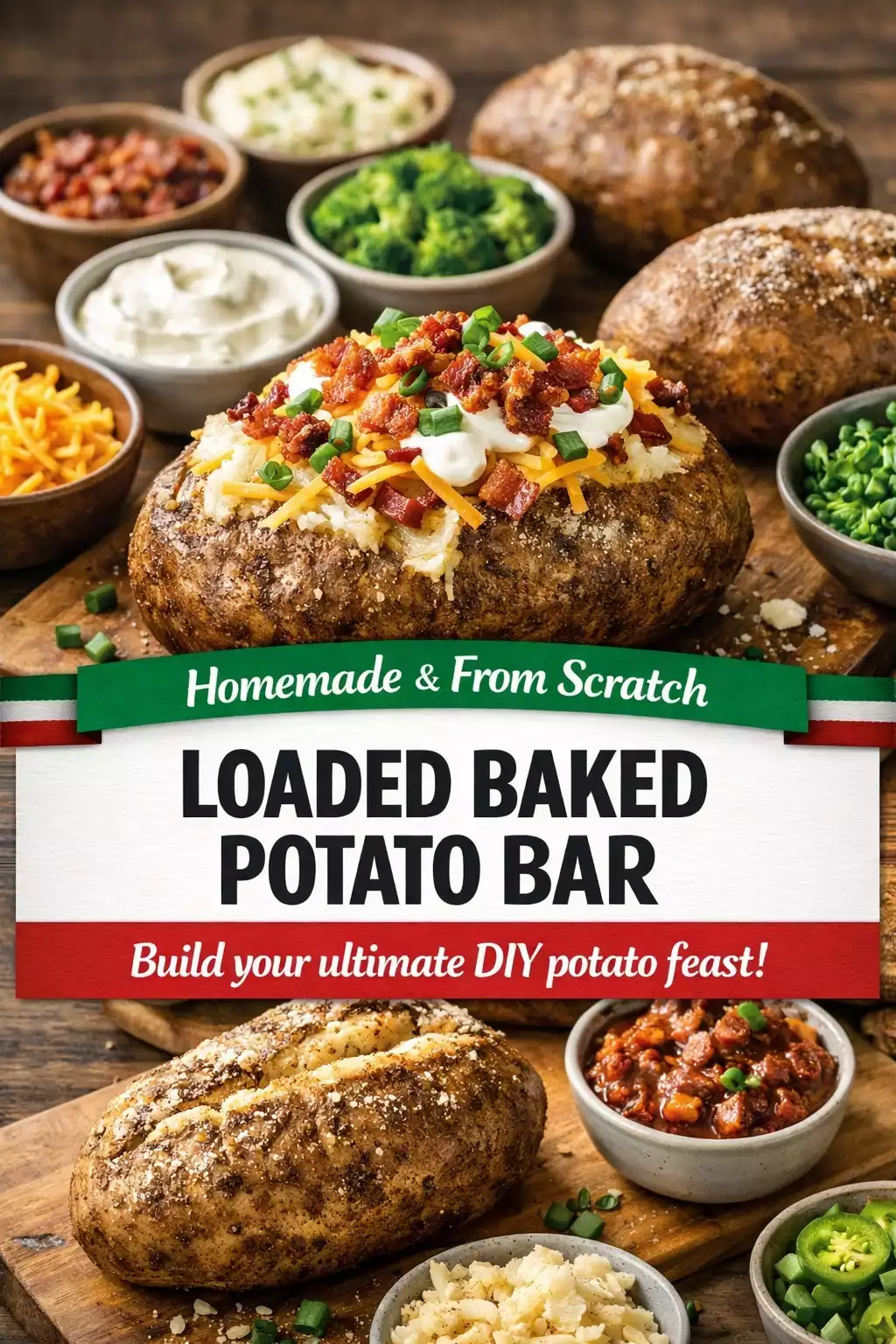
Three generations of this recipe. You’re welcome. Loaded Baked Potato Bar — the dinner concept that solves the problem of feeding people with different preferences without making four different meals. The baked potato is the canvas. Everything else is personal. My family has been doing this for Sunday dinners since before I was old enough to hold a spoon, and the format never gets old because the potato never changes but the toppings change with whatever’s in the refrigerator, the season, or the mood.
The loaded baked potato bar is also, secretly, one of the best entertaining formats there is. It scales infinitely, requires minimal last-minute cooking, and everyone builds exactly what they want. I’ve done it for two people on a Tuesday and for twenty people at a Super Bowl party. The result is always the same: the potato is perfect and the toppings carry the meal.
For the complete potato repertoire, pair with Perfect Mashed Potatoes, Twice Baked Potatoes, Homemade French Fries, Crispy Roasted Potatoes, and Southern Potato Salad.
Why This Baked Potato Method Works
- 400°F directly on the rack: High heat, circulating air, and no sheet pan produce a properly crispy, dry skin — the hallmark of a well-baked potato. Pan-baked potatoes steam underneath and never develop that satisfying crunch.
- Oil and salt the skin: A rubbed-in coating of oil and coarse salt produces a seasoned, crackling exterior that’s worth eating on its own.
- No foil: Wrapping in foil steams the potato into a soft, pale wrapper that has nothing in common with a properly baked skin. Foil is for keeping baked potatoes warm after cooking. Not during.
- Internal temperature 200°F: A fully cooked baked potato. No visual cue is as reliable as a thermometer — or the squeeze test (the potato should yield easily and feel hollow inside when squeezed with an oven mitt).
- The rest split: Cutting into the potato immediately and fluffing the interior prevents sogginess by releasing steam. Cutting and squeezing the ends together produces that familiar texture-puffed shape.
The Bar Setup
The Potatoes
- Large russet potatoes (1 per person)
- Olive oil or neutral oil (for rubbing)
- Coarse sea salt or kosher salt
Classic Toppings
- Sour cream
- Shredded sharp cheddar
- Cooked bacon, crumbled
- Chives or green onions, sliced
- Salted butter
- Black pepper
Elevated Toppings
- Broccoli florets, steamed
- Pulled pork or shredded chicken
- Chili (beef or vegetarian)
- Blue cheese crumbles
- Caramelized onions
- Jalapeño slices
- Hot sauce selection
Instructions
Step 1: Prep and Bake the Potatoes
Preheat oven to 400°F. Scrub potatoes and dry thoroughly. Rub each with oil until fully coated, then rub with coarse salt. Pierce each potato 10–12 times all around with a fork — this prevents steam buildup and potential splitting. Place directly on the oven rack. Bake 55–65 minutes until a fork slides in with zero resistance or until an internal thermometer reads 200°F.
Step 2: Rest and Open
Remove from oven and let rest 5 minutes. Score a lengthwise cut across the top, then a shorter crosswise cut perpendicular. Squeeze the ends toward the center with an oven mitt to push the flesh up and out — the classic presentation. Fork the exposed flesh lightly. Season immediately with a pinch of salt and black pepper.
Step 3: Set the Bar
Arrange all toppings in separate small bowls. Put the classic toppings closest to the potatoes. Butter first, then sour cream, then cheese, then the customizable additions. Label anything that might be unfamiliar. Have a hot sauce selection available regardless of the crowd — someone always wants it.
Pro Tips & Mistakes to Avoid
- Never use foil during baking: Foil prevents skin from crisping. Use it only after baking to keep potatoes warm for service.
- Don’t skip the oil and salt rub: The skin of a properly seasoned, oiled potato is worth eating. An unseasoned skin is not.
- Pierce before baking: A pressure buildup inside a sealed potato can cause it to burst in the oven. Piercing is a mandatory safety step, not optional.
- Size matters for timing: Large supermarket russets (the size typically labeled “baking potatoes”) need 55–65 minutes. Smaller potatoes need less. Don’t guess — feel for doneness with a fork or thermometer.
Topping Combinations Worth Building
- Classic Steakhouse: Butter + sour cream + cheddar + bacon + chives. The standard. Not broken. Don’t fix it.
- Chili Potato: Beef chili + cheddar + sour cream + jalapeños + green onion. A complete meal in a shell.
- Broccoli Cheddar: Steamed broccoli + cheddar sauce (or just shredded cheddar) + sour cream. Elevated diner energy.
- BBQ Pulled Pork: Slow-cooked pulled pork + barbecue sauce + slaw + pickled onions. A Southern feast in a potato shell.
- Italian-American: Marinara + ricotta + basil + Parmesan. My nonna’s version, done in a potato instead of pasta.
Storage & Reheating
- Baked potatoes: Refrigerate up to 4 days. Reheat at 375°F for 15–18 minutes directly on the rack — the skin re-crisps. Microwave for 2–3 minutes is faster but softens the skin.
- Toppings: Store separately. Sour cream, cheese, and chives keep 3–5 days. Cooked bacon keeps well for 5 days refrigerated.
- Batch baking: Bake 6–8 potatoes at once. Refrigerate unused potatoes. Reheat on demand through the week for fast weeknight meals.
Frequently Asked Questions
How long does a baked potato take at 400°F?
55–65 minutes for a large supermarket russet. Smaller potatoes: 45–50 minutes. Always check with a fork or thermometer — oven temperatures vary and potato size varies. A potato that’s not fully cooked is a disappointment. One that’s slightly overbaked is still fine.
Should I oil the skin?
Yes. Oil + salt produces a seasoned, slightly crispy skin that’s worth eating as part of the dish. A dry, unseasoned potato skin is just a container. A well-prepared potato skin is part of the meal.
Microwave or oven?
Oven for the full experience — proper skin, fluffy interior. Microwave for 5–6 minutes when time is the constraint — the interior is fine, the skin will be soft and pale. A hybrid approach: microwave 4 minutes, then 400°F oven for 15 minutes to crisp the skin. Best of both.
How do I keep baked potatoes warm for a crowd?
Wrap individual baked potatoes in foil immediately after baking. Place in a low oven (200°F) or a warming drawer. They hold for up to 1 hour with minimal quality loss. Beyond 1 hour, the skin softens from the steam trapped by the foil.