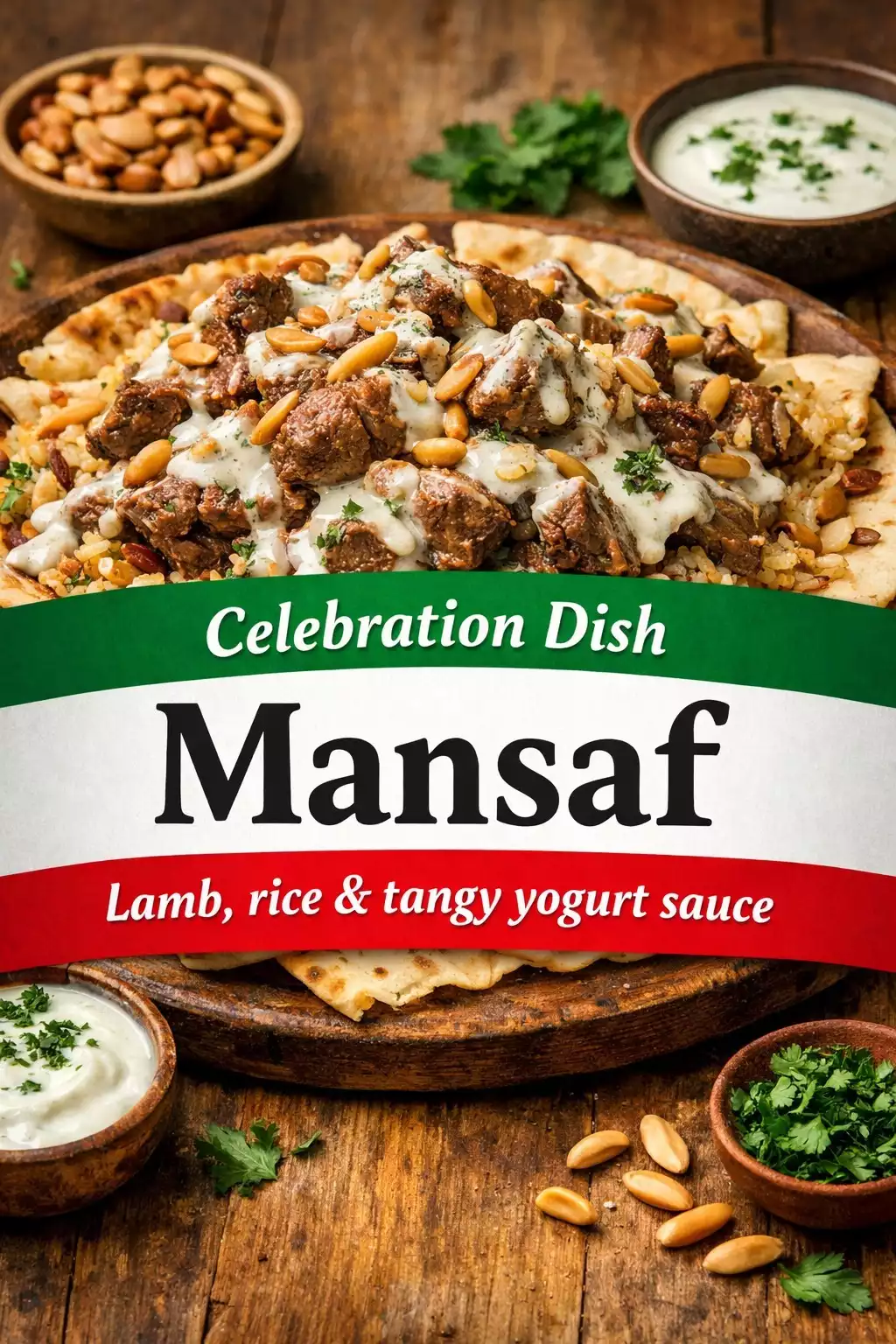
Three generations of this recipe. You’re welcome. Mansaf is Jordan’s national dish, and calling it a rice dish would be like calling the Sistine Chapel a ceiling painting. This is a monument. Slow-cooked lamb in tangy fermented yogurt sauce — jameed — served over spiced rice with toasted nuts, and eaten the traditional way: gathered around a large communal platter, standing, with the right hand, bread used as a scoop. It’s a celebration dish. A wedding dish. A dish that entire communities make together because no one person should have to carry the weight of cooking it alone.
The jameed is the irreplaceable element. Dried, fermented sheep’s milk yogurt from Jordan — sold in blocks or jars at Middle Eastern grocery stores. It reconstitutes into a tangy, complex sauce unlike anything else in cooking. If you can’t find it, there are approximations, but understand: it won’t be the same dish. It’ll be a very good lamb rice. Not Mansaf.
Why This Mansaf Works
- Properly reconstituted jameed: Soaking dried jameed overnight in warm water, then blending smooth, creates the authentic sauce base. The fermented tang is the flavor identity of this dish.
- Low and slow lamb: Bone-in lamb shoulder or leg, simmered 2–3 hours until falling off the bone. This isn’t a shortcut dish. The collagen from the bones enriches the jameed sauce.
- Controlled heat for jameed: Jameed sauce must be stirred constantly when added to heat — it will split at high temperatures. Low, slow, and constant stirring is essential.
- Spiced rice base: Basmati rice cooked with lamb broth, cinnamon, and turmeric — the rice absorbs everything and serves as the fragrant foundation.
- The presentation layer: Flatbread goes down first, rice on top, lamb on top of that, sauce ladled over everything. The layering is structural and traditional.
Ingredients
The Lamb
- 3 lbs bone-in lamb shoulder or leg, cut into large pieces
- 1 large onion, halved
- 3 cardamom pods
- 2 cinnamon sticks
- 4 whole cloves
- 1 bay leaf
- Salt and pepper
- Water to cover
The Jameed Sauce
- 1 lb jameed (dried fermented yogurt), soaked overnight and blended smooth, OR 2 cups jarred liquid jameed
- 2 cups reserved lamb cooking broth
- 2 tbsp butter
- Salt to taste
The Rice
- 2 cups basmati rice, rinsed and soaked 30 minutes
- 3 cups reserved lamb broth
- 2 tbsp butter or ghee
- 1 tsp turmeric
- ½ tsp cinnamon
- Salt to taste
The Finish
- ½ cup blanched almonds, toasted in butter
- ¼ cup pine nuts, toasted
- Fresh flat-leaf parsley, chopped
- Flatbread (khubz or markook) for the base layer
Instructions
Step 1: Cook the Lamb
Place lamb pieces in a large pot with the onion, whole spices, salt, and enough water to cover by 2 inches. Bring to a boil, skim foam thoroughly, then reduce heat and simmer covered for 2–3 hours until the lamb is completely tender and falling from the bone. Remove lamb and set aside. Strain and reserve the broth — it’s gold. You’ll need it for the rice and the jameed sauce.
Step 2: Prepare the Jameed Sauce
If using dried jameed, soak overnight in warm water, then blend with some of the soaking liquid until completely smooth. Strain through a fine mesh strainer. Combine the blended jameed with 2 cups of warm lamb broth in a pot. Heat over medium-low, stirring constantly — do not walk away. The sauce will break if overheated or left unstirred. Heat until just simmering and slightly thickened, about 10–15 minutes. Add butter and taste for salt. Keep warm on the lowest setting.
Step 3: Cook the Spiced Rice
Heat butter or ghee in a heavy pot. Add drained rice and toast briefly, 2–3 minutes, stirring constantly. Add 3 cups of warm lamb broth, turmeric, cinnamon, and salt. Bring to a boil, stir once, cover, and reduce heat to the lowest setting. Cook 15 minutes undisturbed. Remove from heat and let rest 10 minutes, covered.
Step 4: Assemble the Mansaf
Lay flatbread across a very large round platter or tray. Spoon the cooked rice over the bread in a mounded layer. Arrange the lamb pieces over and around the rice. Ladle a generous amount of the warm jameed sauce over everything — be liberal. Reserve remaining sauce for the table. Top with toasted almonds and pine nuts, and scatter fresh parsley. Serve additional sauce on the side. The dish is traditionally eaten standing, pulling pieces from the platter by hand or with flatbread.
Tips & Common Mistakes
- Jameed splitting: The fermented yogurt base is protein-rich and sensitive to heat. Constant stirring over low heat is the only way to prevent breaking. If it does split, remove from heat and whisk vigorously — it sometimes comes back together.
- Finding jameed: Look at Middle Eastern or Jordanian grocery stores. Online ordering from specialty Middle Eastern food importers also works. Ask for “jameed” — the dried block form or the liquid jarred form. Both work.
- Don’t skip bone-in lamb: Boneless lamb works but won’t enrich the broth the way bone-in cuts do. The collagen from bones is what gives the sauce its body.
- Reserve enough broth: You need 5+ cups total — for the sauce and the rice. Make more lamb than you think you need so you always have enough broth.
- Toasting the nuts: Toast in butter over medium heat, not in a dry pan. The butter browning along with the nuts adds a level of richness that dry-toasting doesn’t achieve.
Variations
- Chicken mansaf: A lighter version using whole chicken instead of lamb. Cook the chicken in spiced broth (shorter time — about 1 hour), build the jameed sauce with chicken broth. Popular in urban Jordan and with younger cooks.
- Yogurt approximation: If jameed is truly unavailable, combine 2 cups plain full-fat Greek yogurt with 1 cup goat’s milk yogurt, a tablespoon of dried buttermilk powder, and a squeeze of lemon. Not authentic, but closer than plain yogurt alone.
- Mansaf rice variations: Some families add vermicelli to the rice. Others stir fried onions into the rice after cooking. The core technique remains the same.
Build the full Middle Eastern table with the Chicken Shawarma, the Crispy Falafel, the Persian Herb Rice (Sabzi Polo), and a bowl of Shakshuka to start. Also try the Lamb Kofta for another lamb classic.
Storage & Reheating
- Refrigerator: Lamb keeps 4 days. Rice keeps 4 days. Jameed sauce keeps 3–4 days. Store components separately for best results.
- Reheating lamb: Reheat in a covered pan with a splash of broth to prevent drying. Low and slow.
- Reheating jameed sauce: Reheat on the stovetop over very low heat, stirring constantly, as when originally made. Never microwave — the rapid uneven heat will split the sauce.
Frequently Asked Questions
What does jameed taste like?
Sharp, tangy, deeply savory, and funky in the best possible way — similar to the fermented character of aged cheese or miso, but with a distinct sheep’s milk quality. It’s unlike any other cooking ingredient. Once you taste Mansaf made with real jameed, imitations become obvious.
Is mansaf eaten with utensils?
Traditionally, no. Mansaf is a communal dish eaten standing around the platter, using the right hand and flatbread to scoop portions. In formal settings, utensils are provided. At home celebrations, the traditional eating method is still observed by many families.
How many does this recipe serve?
This recipe serves 6–8 as a main. Mansaf is traditionally a celebration dish and scales beautifully — doubling or tripling is common for weddings and large gatherings.
Can I make this in a slow cooker?
The lamb absolutely can be cooked in a slow cooker — 8 hours on LOW produces incredibly tender results. The jameed sauce must still be made on the stovetop with constant stirring. Don’t attempt to make the sauce in the slow cooker — the temperature fluctuation will cause splitting.