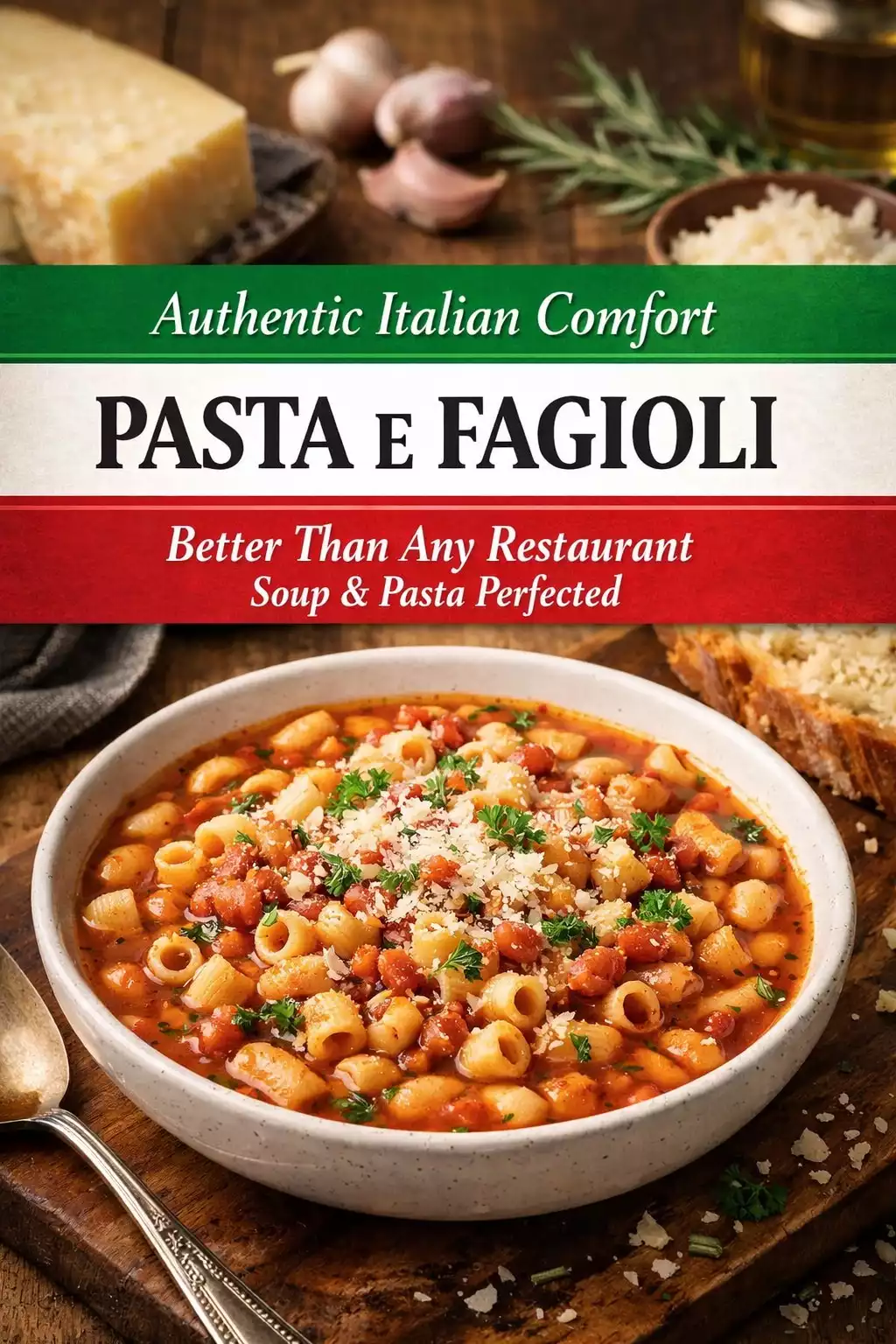
People pay $30 for this at restaurants. You’re making it for six bucks. Pasta e fagioli — pasta and beans — is the Italian-American working family soup that has been feeding people through every economic hardship this country has ever seen. My family made it through the Depression, through lean seasons, through every Tuesday when the refrigerator was close to empty. Two cans of beans, a little pasta, some broth, garlic and herbs, and thirty minutes. That’s all it’s ever needed.
The Italian tradition goes back centuries — fagioli e pasta, beans and pasta, in every region of Italy under different names and with different beans. The Italian-American version converges around white cannellini beans, ditalini or small pasta, and a broth that’s thickened by the beans themselves when some are mashed into the liquid. My family’s version always started with soffritto, always had pancetta, always had fresh Parmigiano at the table. Not a garnish — a requirement.
This pasta e fagioli uses the full technique — proper soffritto, rosemary and bay leaf, beans added in two stages (whole and mashed) to build the thick, starchy broth that’s the whole point of the dish. This is not minestrone. Pasta e fagioli has a specific texture and a specific bean-forward character that makes it its own thing.
Why This Pasta e Fagioli Works
- Two-stage bean addition — half the beans go in whole; half are mashed into the broth; the mashed beans thicken the soup into the characteristic creamy-dense texture
- Pancetta renders first — the rendered fat is the foundation; every aromatic that follows builds on pork fat flavor
- Parmesan rind in the broth — an authentic Italian-American technique; the rind releases gelatin and deep umami as it simmers; don’t skip it if you have one
- Pasta cooked in the soup — the pasta releases starch directly into the broth, thickening it further and absorbing the bean and herb flavors
- Low and slow simmer — soup that boils aggressively breaks down the beans too quickly and loses the textural contrast between whole beans and broth
Ingredients
For the Soup
- 3 oz pancetta or thick-cut bacon, diced
- 1 medium onion, finely diced
- 3 stalks celery, finely diced
- 1 medium carrot, finely diced
- 5 cloves garlic, minced
- 2 cans (15 oz each) cannellini beans, drained and rinsed
- 1 can (14.5 oz) crushed tomatoes or diced tomatoes
- 4 cups chicken stock or vegetable stock
- 2 cups water
- 2 sprigs fresh rosemary (or 1 teaspoon dried)
- 1 bay leaf
- 1 Parmigiano rind (if available — significant upgrade)
- 1 teaspoon kosher salt
- ½ teaspoon black pepper
- Red pepper flakes to taste
- 3 tablespoons olive oil
For the Pasta
- 1 cup ditalini, elbow macaroni, or small pasta shells
For Serving
- Freshly grated Parmigiano-Reggiano (heavy hand)
- Good-quality extra virgin olive oil for drizzling
- Fresh flat-leaf parsley, chopped
- Crusty Italian bread
Instructions
Step 1: Render the Pancetta and Soffritto
In a large Dutch oven over medium heat, add olive oil and diced pancetta. Render slowly 4–5 minutes until fat is released and pancetta starts to crisp. Add onion, celery, and carrot. Cook over medium-low for 10 minutes until completely softened. Add garlic and red pepper flakes and cook 1 more minute. Season lightly with salt.
Step 2: Build the Soup Base
Add the crushed tomatoes to the soffritto and cook 3–4 minutes, stirring, until incorporated. Add chicken stock, water, rosemary sprigs, bay leaf, and Parmigiano rind if using. Bring to a simmer. Season with salt and pepper.
Step 3: Two-Stage Bean Addition
Add half the cannellini beans to the soup whole. Mash the remaining half with a fork or the back of a spoon in a small bowl until roughly pureed — not smooth, just broken down with some texture. Add the mashed beans to the soup and stir to incorporate. The mashed beans instantly begin thickening the broth. Simmer for 20 minutes for the flavors to develop and the mashed beans to fully integrate. Remove rosemary sprigs, bay leaf, and Parmigiano rind. Taste and adjust salt.
Step 4: Cook the Pasta in the Soup
Bring the soup to a steady simmer. Add the ditalini directly to the soup — not in a separate pot. Cook 8–10 minutes until pasta is just tender. The pasta will continue absorbing liquid after cooking; serve immediately or the pasta will become very thick. If making ahead, cook pasta separately and add individual portions at serving time.
Step 5: Serve
Ladle into warm bowls. Drizzle generously with your best extra virgin olive oil. Add a heavy application of freshly grated Parmigiano-Reggiano. Finish with fresh parsley and a crack of black pepper. Serve with crusty bread for tearing and dipping. This is a complete meal. It needs nothing else except the people around your table.
Chef’s Tips & Common Mistakes
- Two-stage beans are the technique — whole beans plus mashed beans is what creates the characteristic thick, creamy-dense broth; using only whole beans gives you minestrone
- Parmigiano rind is not optional if you have it — save your Parmigiano rinds in a zip-lock bag in the freezer; drop one into pasta e fagioli and the difference is remarkable
- Cook pasta in the soup, not separately — the starch from the pasta cooks directly into the broth and thickens it; pasta cooked separately and added later misses this
- Serve immediately after pasta is cooked — pasta e fagioli with pasta cooked ahead becomes an extremely thick, almost stiff preparation; make to order and serve hot
- Don’t skip the olive oil drizzle at serving — the finishing olive oil is a primary flavor component, not garnish; use your best oil for this step
- Taste and salt throughout — beans and pasta both absorb salt; season at soffritto stage, after adding beans, and again before serving
Variations
- Vegetarian Version: Skip pancetta and use vegetable stock; add a tablespoon of olive oil to compensate for the missing pork fat; use the Parmigiano rind if vegetarian-friendly
- With Kale or Escarole: Add 2 cups roughly chopped kale or escarole in the last 5 minutes — classic Italian-American addition that adds greens and a slightly bitter contrast
- Borlotti Bean Version: Substitute borlotti (cranberry) beans for cannellini — the traditional Venetian version with a more robust, earthy flavor
- Chunky vs. Creamy: For a creamier version, blend one full cup of beans until smooth and return to the soup — a completely creamy texture vs. the partial mash of this recipe
- Lentil Pasta Cousin: Compare with lentil pasta sauce — similar Italian-American legume-pasta tradition; lentil sauce is thicker and used as pasta sauce; pasta e fagioli is soupier and eaten in bowls
- Slow Cooker Version: Build soffritto in a skillet, transfer everything to slow cooker, cook on low 6–8 hours; add pasta in the last 30 minutes; serve immediately
Storage & Reheating
Refrigerator: Store soup without pasta up to 5 days. The soup improves significantly on day 2. If pasta was cooked in the soup, it continues absorbing liquid and the soup becomes extremely thick — add stock or water when reheating.
Reheating: Reheat in a saucepan over medium heat with a splash of water or stock to loosen. Bring to a simmer and adjust seasoning. Add freshly cooked pasta if soup was stored without pasta.
Best Practice: Store the soup base (beans, vegetables, broth) without pasta. Cook fresh pasta directly in the soup for each serving. This is the professional approach that maintains ideal texture every time.
Freezer: Freeze the soup base without pasta for up to 4 months. Thaw overnight and reheat. Add fresh pasta when serving. One of the best freezer soups in the Italian-American repertoire.
Frequently Asked Questions
Can I use dried beans instead of canned?
Yes — and the flavor is noticeably better. Soak 1 lb dried cannellini beans overnight, drain, then cook in the soup base until tender (about 90 minutes) before mashing half. The bean cooking liquid is flavor gold — use it as part of the soup liquid. Total cooking time with dried beans: about 2 hours. Worth it on a weekend. See tuna pasta for a similarly pantry-based Italian-American dish that uses canned ingredients to great effect.
What pasta shape is traditional for pasta e fagioli?
Ditalini (small tubes) is the most traditional Italian-American shape — each tube fills with the bean broth and the bite includes pasta, whole beans, and thick soup simultaneously. Elbow macaroni is the home-kitchen substitute. Any small pasta shape works. Avoid large shapes that overwhelm the beans and spaghetti broken into pieces — the traditional approach uses shapes that remain uniform throughout the soup.
Why is my pasta e fagioli too thick?
The pasta absorbed too much liquid during cooking or storage. This is not a flaw — extremely thick pasta e fagioli is traditional in Naples, where it’s eaten with a fork rather than a spoon. To thin it out: add stock or water and stir over medium heat. To prevent future over-thickening: cook pasta in the soup only at serving time and serve immediately after the pasta is done.
Should pasta e fagioli be thick or soupy?
Regional and family preference. The Southern Italian version (Neapolitan) is thick, almost stew-like, eaten with a fork. The Northern Italian version is looser, soupier, eaten with a spoon. Italian-American home cooking tends toward the thick version. This recipe is medium-thick — spoonable but not watery. Adjust by controlling how much pasta you add and how long you simmer. See Greek orzo chicken soup for a comparison of a broth-forward pasta-in-soup dish.
Can I make this without the Parmigiano rind?
Yes — the rind is an upgrade, not a requirement. Without it, the soup is still excellent. To add back some of the depth the rind provides: a splash of soy sauce or a teaspoon of Worcestershire added early in the simmer provides umami without being detectable. Or add 2 tablespoons of nutritional yeast at the end for a similar depth without dairy.