Simple ingredients, proper technique. That’s the whole game. Shepherd’s Pie — even a budget version — is one of those dishes where if you nail the three components (seasoned meat filling, proper gravy, properly mashed potatoes), the result is something that punches far above its cost. This is honest, filling, real food. The kind of thing that makes a cold November night feel right.
The budget angle here means ground beef instead of lamb, with smart ingredient choices that keep cost low without sacrificing flavor. The Worcestershire, tomato paste, and aromatics do the heavy lifting in the filling. The potatoes get proper treatment — warm cream, real butter, actual salt — not a shortcut. A shepherd’s pie where the mashed potatoes are stiff and underseasoned is a disappointment regardless of what the filling tastes like. Both layers need to be right.
For more budget-conscious ground beef recipes, explore homemade meatballs and best meatloaf recipe as economical but serious dishes. For braised and slow-cooked beef options that use similar inexpensive cuts, see beef stroganoff recipe and beef stuffed bell peppers.
Why This Works
- Tomato paste caramelized in the pan: Cooking tomato paste for 2 minutes in the fat before adding liquid creates a richer, more concentrated tomato flavor and eliminates the raw tomato taste that makes some shepherd’s pie fillings taste one-dimensional.
- Worcestershire as the umami backbone: This ingredient bridges the gap between cheap ground beef and the deeper, meatier flavor of the lamb or quality beef in more expensive versions. It’s the flavor amplifier that makes the budget version taste like it should.
- Warm dairy in the mash: Cold butter added to hot potatoes doesn’t incorporate properly and results in lumpy, separated mash. Warm cream absorbs evenly. The potatoes should be riced or mashed with warm dairy for the smoothest result.
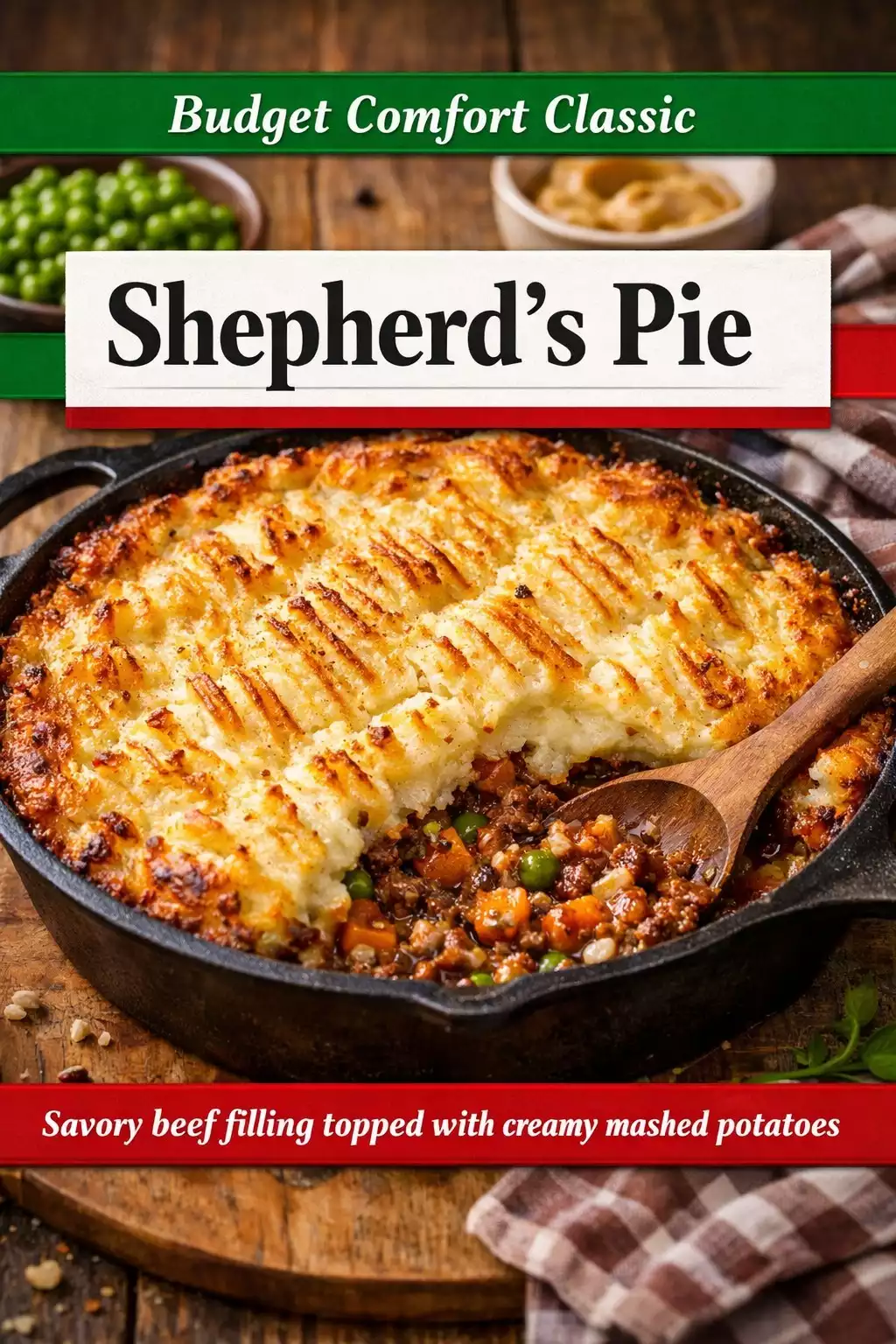
- Fork marks on the mash: Running a fork across the top of the potato layer creates ridges that brown in the oven into crispy peaks. This is not decoration — it creates texture contrast between the crispy top and the soft interior.
Ingredients
For the Filling
- 1.5 lbs ground beef (80/20)
- 1 large yellow onion, diced
- 2 carrots, diced small
- 2 stalks celery, diced small
- 3 cloves garlic, minced
- 2 tablespoons tomato paste
- 2 tablespoons Worcestershire sauce
- 1 cup beef broth
- 1 cup frozen peas
- 2 tablespoons all-purpose flour
- 1 teaspoon dried thyme
- 1 teaspoon dried rosemary
- Salt and black pepper
- 1 tablespoon olive oil
For the Mashed Potato Topping
- 2.5 lbs Russet or Yukon Gold potatoes, peeled and cubed
- 4 tablespoons unsalted butter
- ½ cup warm milk or heavy cream
- Salt to taste
- Optional: 1 egg yolk for extra richness
Instructions
Step 1: Make the Mashed Potatoes
Boil peeled, cubed potatoes in salted water until completely tender, about 15-20 minutes. Drain thoroughly. Return to the pot over low heat for 1 minute to evaporate excess moisture. Mash with warm butter and warm milk/cream. Season very generously with salt — properly seasoned mash is one of the most important elements of shepherd’s pie. Set aside.
Step 2: Brown the Beef
Heat oil in a large, oven-safe skillet or saute pan over medium-high heat. Add ground beef and cook without breaking for 2 minutes. Break apart and continue until browned, about 7-8 minutes. Season with salt and pepper. Drain most of the fat, leaving about a tablespoon.
Step 3: Build the Filling
Add onion, carrots, and celery to the beef. Cook 5-6 minutes until the vegetables are softened. Add garlic and cook 1 minute. Sprinkle flour over the mixture and cook, stirring, for 2 minutes — this is the thickener. Add tomato paste, cook 2 minutes, stirring. Add Worcestershire, thyme, rosemary, and beef broth. Scrape the bottom of the pan and bring to a simmer. Cook uncovered for 5-8 minutes until the gravy thickens. Add frozen peas, stir to combine, and season to taste.
Step 4: Assemble
Preheat oven to 400°F. If the skillet is oven-safe, spread the filling evenly. If not, transfer to a greased 9×13 baking dish. Spoon the mashed potatoes over the filling in an even layer. Use the back of a spoon to smooth, then drag a fork across the top to create ridges. Dot with small pieces of butter if desired.
Step 5: Bake
Bake uncovered at 400°F for 20-25 minutes until the potato peaks are golden brown and the filling is bubbling around the edges. Let rest for 10 minutes before serving — the filling needs to set slightly or it will be too liquid to plate cleanly. Serve in portions directly from the pan.
Tips & Common Mistakes
- Season the mash aggressively: Unseasoned mash sitting on top of well-seasoned filling creates an unbalanced dish. The mash layer needs to stand on its own flavor-wise. Taste it separately and make sure it’s properly salted before adding to the dish.
- Don’t make the filling too wet: If the filling is too liquid before going under the mash, it will bubble up through the potato layer and create a watery, messy result. The gravy should be thick enough to coat the back of a spoon before assembly.
- Use Russet for the crust, Yukon for smoothness: Russet potatoes make the crispiest peaks. Yukon Gold makes the smoothest, butteriest mash. For the best of both: half and half, mashed together.
- Let it rest after baking: The filling continues to thicken slightly as it rests. Cutting in immediately produces runny filling that doesn’t hold its shape on the plate. Ten minutes of resting makes a significant difference in plating.
- Use an oven-safe pan to skip a step: If the filling is made in an oven-safe skillet, the mash goes directly on top and the whole thing goes in the oven. One less baking dish to wash.
Variations Worth Trying
- Classic lamb version: Swap ground beef for ground lamb. Lamb shepherd’s pie is the original Irish and British version — the flavor is richer, slightly gamey, and more complex. The technique is identical.
- Cottage pie distinction: Technically, shepherd’s pie uses lamb and cottage pie uses beef. The budget version here is technically a cottage pie. The names are used interchangeably in American kitchens, which is fine.
- Sweet potato topping: Replace the white potato mash with seasoned sweet potato mash. The slight sweetness against the savory filling is a flavor combination that works surprisingly well and adds color to the dish.
- Double cheese version: Mix shredded cheddar into the mash and sprinkle more on top before baking. The cheese browns into a crispy, golden crust that makes the potato layer even more compelling.
- Individual servings: Portion into ramekins for individual shepherd’s pies. Same technique, easier serving, and more impressive presentation for guests. For more individual-portion ground beef dishes, see homemade meatballs or best meatloaf recipe.
Storage & Reheating
- Refrigerator: Store covered for up to 4 days. The dish holds well and reheats beautifully. The filling tightens up slightly overnight, which actually improves the portion stability.
- Freezer: Freeze unbaked (assembled but not yet baked) for up to 2 months. Thaw overnight in the refrigerator and bake as directed, adding 10-15 minutes to the bake time since it’s going in cold. Alternatively, freeze baked portions.
- Reheating: Reheat portions in a 350°F oven covered with foil for 20-25 minutes, removing foil for the last 5 minutes to re-crisp the potato peaks. Microwave in covered containers in 2-minute intervals works for single portions but softens the potato crust.
Frequently Asked Questions
What’s the difference between shepherd’s pie and cottage pie?
Shepherd’s pie uses lamb (shepherd = sheep). Cottage pie uses beef. In American kitchens, the terms are used interchangeably with beef being the default interpretation. Traditional British cooking makes the distinction strictly. Both use the same mashed potato topping and the same basic technique.
Can this be made with leftover mashed potatoes?
Yes, and it’s an excellent use of them. Add a tablespoon of butter and a splash of warm cream to loosen leftover mash before spreading. If the leftover potatoes are thick, they may not spread as evenly — warm them gently first and add liquid as needed to achieve a spreadable consistency.
Why is my shepherd’s pie too watery?
Two likely causes: the filling wasn’t reduced enough before adding the potato layer, or the potatoes weren’t dry enough. For the filling: cook until the gravy clearly coats the back of a spoon before covering with mash. For the potatoes: drain well and return to heat briefly to evaporate excess moisture before mashing.
Can frozen mixed vegetables be used instead of separate carrots and peas?
Yes. A cup of frozen mixed vegetables (peas, carrots, corn) added with the peas in the last step works perfectly. It reduces prep time and provides the vegetable variety without individual chopping. Add them frozen directly to the hot filling.
How do I get the potato peaks to brown properly?
Three keys: fork tracks through the potato layer before baking (more surface area = more browning), dots of butter on top (fat browns before potato starches do), and high enough heat (400°F is the minimum). If the peaks aren’t browning after 25 minutes, switch to broil for 2-3 minutes. Watch it closely under the broiler — it goes from perfect to burnt quickly. See beef stuffed bell peppers for another oven-baked beef dish using similar browning principles.