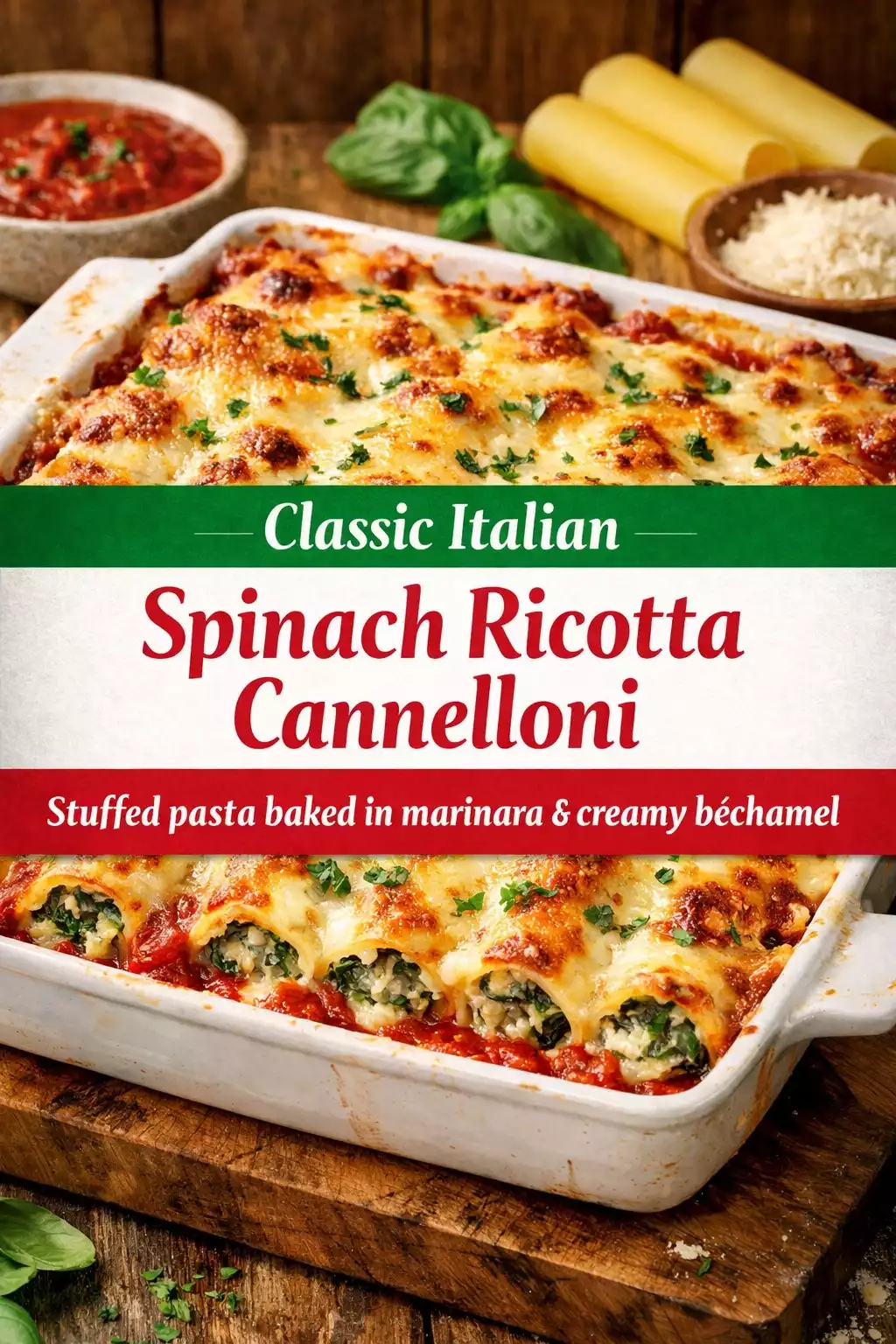
This isn’t the fancy restaurant version. This is the real one. Spinach and ricotta cannelloni is the dish my great-aunt used to make for the whole family at Easter — a big ceramic baking dish arriving at the table covered in bubbly béchamel and marinara, the filling peeking out from the ends of each tube. It smelled like Sunday and tasted like something you’d cross town to eat.
Cannelloni is less intimidating than its reputation suggests. Yes, you’re stuffing individual pasta tubes. But with a piping bag or a zip-lock with the corner cut off, the whole process takes about fifteen minutes. The real work is in the two sauces — the béchamel on top and the marinara underneath — and both can be made ahead. Everything can be assembled the day before. Put it in the oven an hour before dinner and let the kitchen do the work.
This spinach and ricotta cannelloni uses the proper two-sauce technique — marinara underneath to keep the pasta tubes moist, béchamel on top to create the golden, custard-like crust that defines the dish. No one sauce. Both. That’s the Italian-American home-cooking standard that produces restaurant results.
Why This Spinach Ricotta Cannelloni Works
- Two sauces serve different purposes — marinara underneath keeps the pasta from drying out and adds tomato depth; béchamel on top creates the golden baked crust
- Filling is properly drained — spinach and ricotta both release water when heated; thoroughly draining both prevents a watery filling
- Nutmeg in the filling — the Italian instinct for nutmeg in cheese and spinach preparations is justified; it elevates both components
- Béchamel is thicker than standard — it’s going on top of a baked dish and needs to set into a golden crust, not run off
- Covered then uncovered baking — covered keeps moisture in while the pasta cooks through; uncovered creates the browned top that makes this dish
Ingredients
For the Filling
- 2 lbs whole-milk ricotta, drained overnight
- 2 packages (10 oz each) frozen spinach, thawed and squeezed very dry
- 2 eggs
- 1 cup freshly grated Parmigiano-Reggiano
- 1 teaspoon kosher salt
- 1 teaspoon freshly cracked black pepper
- ¼ teaspoon freshly grated nutmeg
For the Pasta and Sauces
- 16–18 cannelloni tubes (dried) or fresh lasagna sheets rolled into tubes
- 3 cups good-quality marinara (homemade or jarred)
- 3 cups béchamel sauce (see white sauce pasta for the technique)
- 1 cup shredded mozzarella for topping
- ½ cup Parmigiano-Reggiano for topping
Instructions
Step 1: Prepare the Filling
The night before (or at least 2 hours ahead): place ricotta in a fine-mesh strainer, refrigerate to drain. For the spinach, thaw and place in a clean kitchen towel. Twist and squeeze until no more water comes out — then squeeze again. Water-laden spinach is the enemy of the filling. Combine well-drained ricotta, spinach, eggs, Parmigiano, salt, pepper, and nutmeg. Mix until uniform. Taste and adjust seasoning — the filling needs to be well-seasoned on its own since it’s surrounded by sauces once baked.
Step 2: Make the Béchamel
Follow the béchamel technique from white sauce pasta: cook butter and flour together for 2 minutes, add warm milk gradually while whisking, simmer until thickened enough to coat a spoon. Season with salt, white pepper, and nutmeg. For cannelloni, the béchamel should be slightly thicker than a standard pasta sauce — it needs to hold its shape on top of the tubes rather than run between them. Set aside.
Step 3: Fill the Cannelloni
Transfer the ricotta filling to a piping bag or zip-lock bag. If using dried cannelloni tubes, no pre-cooking is needed for most brands — check the package. Pipe the filling into each tube from one end until the tube is full but not bursting. For fresh lasagna sheets: spoon filling along the bottom edge and roll into a log. Place filled tubes seam-side down.
Step 4: Assemble
Preheat oven to 375°F. Spread 1½ cups marinara on the bottom of a 9×13 baking dish (two dishes if making the full batch). Place filled cannelloni tubes in a single layer on the sauce. They can touch but shouldn’t overlap. Spoon remaining marinara between and lightly over the tubes. Pour the béchamel generously over the entire surface, covering every tube. Scatter mozzarella and Parmigiano evenly on top. Cover with foil.
Step 5: Bake
Bake covered at 375°F for 30 minutes. The pasta should be mostly cooked through and the filling set. Remove foil. Bake uncovered 15–20 more minutes until the béchamel top is deeply golden and the mozzarella is bubbly and beginning to blister. Rest 10 minutes before serving. The rest allows the béchamel to firm and the filling to set so each tube stays intact when served with a spatula.
Chef’s Tips & Common Mistakes
- Drain everything — ricotta needs overnight draining; spinach needs hand-wringing until desert-dry; water from either creates a filling that dissolves
- Nutmeg is not optional — spinach and ricotta are nothing without it; the pinch transforms the filling from bland to distinctly Italian
- Thicker béchamel for this application — a pourable sauce runs into the cracks and leaves the top uneven; a thicker sauce covers completely
- Piping bag makes filling easier — a zip-lock with the corner cut works just as well; trying to spoon filling into tubes with a teaspoon is tedious and messy
- Marinara under and around, not over — béchamel belongs on top; putting marinara on top of béchamel mixes the sauces and loses both their distinct contributions
- Rest 10 minutes without exception — freshly baked cannelloni slides apart; rested cannelloni lifts cleanly with a spatula
Variations
- Meat Cannelloni: Substitute the spinach filling for a ground veal and beef mixture with herbs — classic Italian restaurant “meat cannelloni” that pairs with both marinara and béchamel
- All Béchamel Version: Skip the marinara and use all béchamel — a more delicate, white-sauce-only dish that showcases the filling without tomato competition
- Fresh Pasta Sheets: Roll fresh pasta sheets into tubes instead of dried cannelloni — the fresh pasta has a more delicate texture that elevates the dish significantly
- Stuffed Shells as a Shortcut: When cannelloni tubes are unavailable, use jumbo pasta shells — same filling technique, slightly less formal presentation, see stuffed shells with ricotta
- Creamy Mushroom Filling: Replace spinach with sautéed mushrooms reduced until dry — an earthy autumn variation that pairs particularly well with the béchamel top
- Single-Sauce Simplification: Use only béchamel without marinara, add a spoonful of tomato paste to the sauce for color and acidity — a single-sauce version that’s still authentic in some regional Italian traditions
Storage & Reheating
Refrigerator: Store covered up to 4 days. Cannelloni actually improves on day two as the sauces meld and the filling absorbs flavor from the surrounding sauces.
Reheating: Cover with foil and reheat at 325°F for 20–25 minutes. Individual portions microwave well covered with a damp paper towel.
Freezer: Assemble completely but don’t bake. Freeze for up to 3 months. Thaw overnight in the refrigerator. Bake as directed, adding 10 minutes to covered time from cold. See homemade lasagna for the same assemble-and-freeze approach.
Make-Ahead: Fully assembled cannelloni stores in the refrigerator up to 24 hours before baking. This makes it the ideal dinner party main course — all the work done the day before, oven time only on the day.
Frequently Asked Questions
Do I need to pre-cook dried cannelloni tubes?
Most dried cannelloni tubes are designed to cook in the oven without pre-boiling. Check the package. The covered baking phase with moist sauce usually hydrates the pasta completely in 30 minutes. If the package says boil first, boil for 5 minutes (half the standard time) before filling. Fresh pasta sheets rolled into tubes need no pre-cooking.
How do I get the spinach dry enough?
Thaw overnight in a strainer in the refrigerator. Gather in a clean towel and twist until you think it’s dry, then twist harder. The spinach should feel almost crumbly — that’s how dry it needs to be. Wet spinach dilutes the ricotta filling and creates steam during baking that makes the filling loose and watery. See stuffed shells for the same drainage principle applied to ricotta alone.
Can I use fresh spinach instead of frozen?
Yes — sauté fresh spinach in a dry skillet over high heat until wilted, then gather in a towel and wring dry. Fresh spinach has more flavor and bright color but requires more preparation. You’ll need about 2 lbs fresh spinach to yield the same volume as 2 packages of frozen after cooking and draining.
What’s the difference between cannelloni and manicotti?
Cannelloni are smooth tubes (Italian tradition), while manicotti are ridged tubes with a slightly different shape (Italian-American tradition). Both use the same filling and baking technique. Manicotti tubes are slightly larger and have ridges that hold sauce on the outside. The recipes are interchangeable — use whatever tubes you can find. Related: baked ziti is a simpler cousin in the Italian-American baked tube pasta family.
Can I make the filling ahead?
Yes — the filling stores refrigerated up to 2 days. The béchamel stores refrigerated up to 3 days (reheat gently with a splash of milk to loosen). Assemble and refrigerate up to 24 hours before baking. Making components ahead and assembling day-of is the professional kitchen approach to this dish. See fettuccine Alfredo for the contrast — a dish that must be made and eaten in minutes, the opposite make-ahead approach.