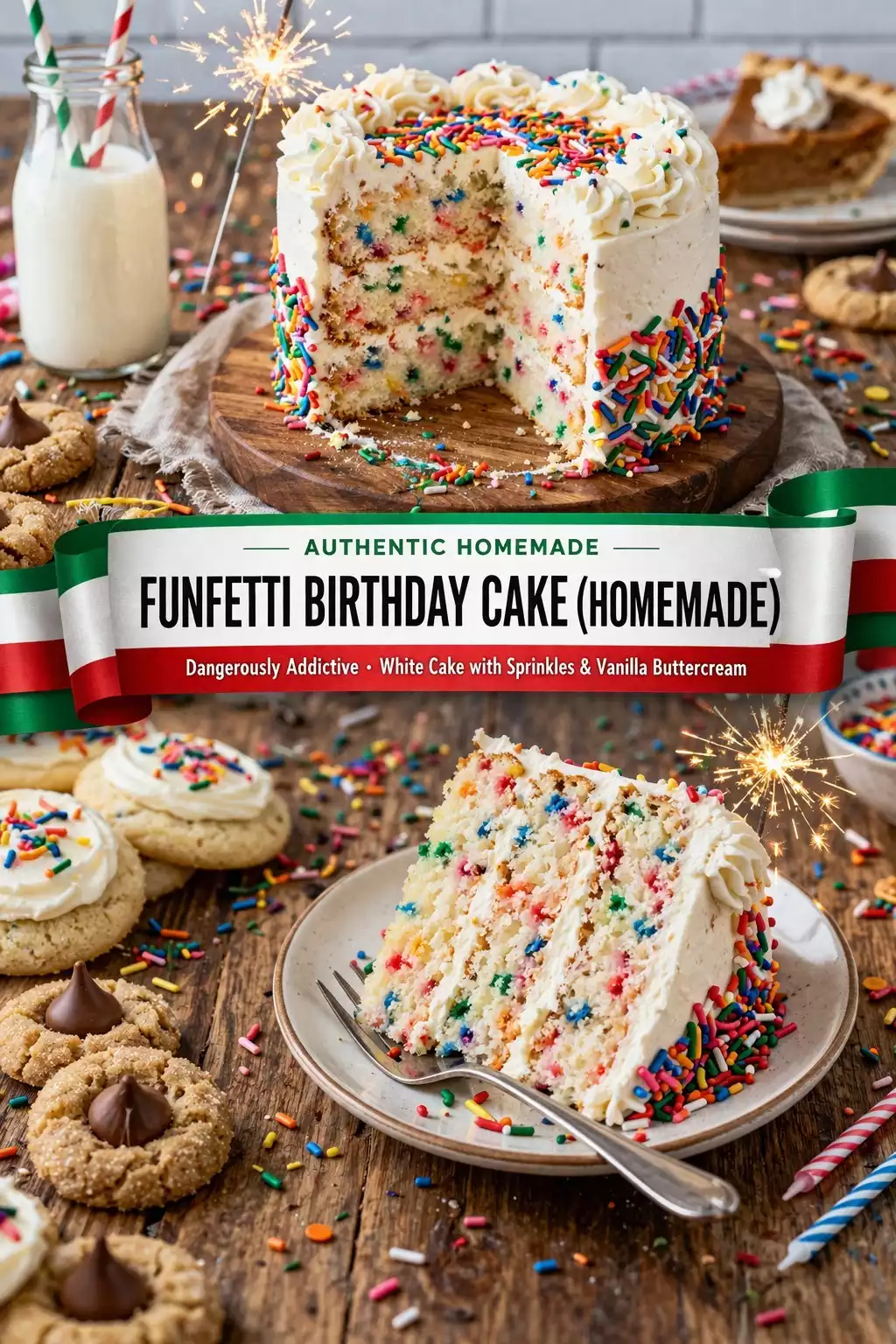
If you can boil water and follow directions, you can make this — and what you’ll end up with is a Simple White Cake that is light, tender, brilliantly white, and better than anything you’ll pull from a box. I’m not a baker by nature. I came up on savory — sauces, braises, technique that uses fire and patience. But when my kids started asking for birthday cake and my wife handed me a mixing bowl and said “figure it out,” I figured it out. Thirty-two years later, this is the cake I make for every occasion that calls for one.
The secret to a white cake that’s actually white is using only egg whites, no yolks. Yolks make a cake yellow. Whites keep it bright, and they also produce a lighter, more delicate crumb — the kind that pulls apart into those tender, fine layers you see in the best bakery cakes. There’s a reason every professional wedding cake starts with a white cake base. This is the recipe that delivers that result at home without a culinary degree.
Pair it with a classic Swiss meringue buttercream or the most straightforward vanilla frosting in the notes below. Or fill the layers with lemon curd and frost with whipped cream. This cake doesn’t demand elaborate decoration — it’s the kind of thing that looks magnificent with three roses on top and one candle, because the cake itself is the showpiece.
Why This White Cake Recipe Works
- Egg whites only — Using only egg whites produces the pure white color and lighter texture that defines a proper white cake. The structure comes from the proteins in the whites, not the fat in the yolks.
- Cake flour over all-purpose — Cake flour has lower protein content, which means less gluten development, which means a finer, more tender crumb. For a white cake specifically, this distinction is very visible in the final texture.
- Reverse creaming method — Mixing butter into flour first (rather than creaming butter and sugar together) coats the flour particles with fat, limiting gluten development and creating an especially tender, fine-crumbed cake.
- Room temperature everything — Cold butter, cold eggs, and cold milk create an uneven batter that bakes unevenly. Room temperature ingredients emulsify together into a smooth, homogeneous batter that rises evenly and sets uniformly.
Ingredients
For the Cake (Two 9-inch Rounds)
- 3 cups cake flour, sifted
- 2¼ teaspoons baking powder
- ¾ teaspoon salt
- 1½ cups granulated sugar
- ¾ cup unsalted butter, room temperature, cut into cubes
- 1¼ cups whole milk, room temperature
- 5 large egg whites, room temperature
- 2 teaspoons pure vanilla extract
- ½ teaspoon pure almond extract (optional but traditional)
For Classic Vanilla Buttercream
- 4 cups powdered sugar, sifted
- 1 cup (2 sticks) unsalted butter, room temperature
- 4-5 tablespoons heavy cream
- 2 teaspoons vanilla extract
- Pinch of salt
Instructions
Step 1: Prep and Preheat
Preheat oven to 350°F. Grease two 9-inch round cake pans with butter, dust with flour, and line the bottoms with parchment paper rounds. Bring all ingredients to room temperature — this takes about 1 hour on the counter and it’s the most commonly skipped step that ruins cakes. Cold ingredients don’t emulsify properly.
Step 2: Mix Dry Ingredients
Sift together cake flour, baking powder, and salt into a large mixing bowl. Add sugar and whisk to combine. Sifting is important here — cake flour clumps and unsifted flour creates dense pockets in the batter. One pass through the sifter is sufficient.
Step 3: Reverse Cream
Add butter cubes to the flour mixture. Using a hand mixer or stand mixer on low speed, mix until the mixture resembles coarse, clumpy crumbs, about 2-3 minutes. Then add ¾ cup of the milk and beat on medium speed for 90 seconds until the mixture becomes fluffy and pale. This is the reverse creaming technique — fat coating flour before liquid is added. The texture change from crumbs to fluffy batter happens noticeably and quickly.
Step 4: Add Egg Whites and Remaining Milk
In a separate bowl, whisk together egg whites, remaining ½ cup milk, vanilla, and almond extract. Add to the batter in three equal additions, beating on medium speed for 20-30 seconds after each addition. The batter should be smooth, pale, and slightly fluffy. Don’t overmix after all the egg whites are in — stop as soon as it looks homogeneous.
Step 5: Bake
Divide batter evenly between prepared pans — use a kitchen scale if possible for even layers. Bake for 28-33 minutes until the tops are pale golden, the edges pull slightly away from the pan, and a toothpick inserted in the center comes out clean or with a few dry crumbs. Don’t overbake — white cake dries out faster than yellow cake because of the missing yolk fat. Begin checking at 28 minutes.
Step 6: Cool and Frost
Cool in pans for 10 minutes, then invert onto a wire rack and cool completely — at least 1 hour. Never frost a warm cake. Beat buttercream ingredients together until fluffy, starting on low to avoid a sugar cloud, then increasing to high for 3-4 minutes until light and airy. Frost the cooled layers, stack, and frost the exterior.
Tips & Common Mistakes
- Room temperature is not optional: Cold butter won’t blend into the flour properly. Cold egg whites don’t whip into the batter smoothly. Cold milk creates an uneven batter. Set everything out one hour before baking.
- Don’t open the oven early: Opening the oven before 25 minutes causes a temperature drop that can make a white cake collapse in the center. Resist until the minimum time has passed.
- Level the layers before frosting: Slice off any dome that formed on top of each layer to create flat surfaces that stack evenly. A serrated knife and a steady hand is all that’s needed — or a cake leveling tool for precision.
- Weigh the batter: Uneven layers are the most common amateur baking problem. A kitchen scale costs $15 and eliminates the guesswork completely. Divide by weight for identical layers every time.
- Sift the cake flour: Unsifted cake flour packs into the measuring cup and throws off the ratio. Sifting before measuring (or sifting after measuring into the bowl) corrects this. One pass is sufficient.
Variations Worth Trying
- Lemon White Cake: Add 2 tablespoons of lemon zest and 2 tablespoons of fresh lemon juice to the batter. Replace the vanilla buttercream with lemon curd between layers and lemon Swiss meringue buttercream on the outside.
- Coconut White Cake: Replace ¼ cup of milk with coconut cream. Add ½ teaspoon of coconut extract. Press toasted coconut flakes into the frosted exterior. A summer celebration cake.
- Almond White Cake: Double the almond extract to 1 teaspoon, reduce vanilla to 1 teaspoon. Top with toasted sliced almonds. The almond note gives the cake an elegant, bakery-style depth.
- Confetti Cake: Fold ½ cup of rainbow sprinkles (jimmies, not nonpareils — they bleed) into the finished batter. The classic childhood birthday cake, elevated.
For more baking essentials, try classic bread pudding, gooey butter cake, foolproof pie crust, edible cookie dough, and classic marshmallow treats.
Storage & Reheating
- Unfrosted layers: Wrap tightly in plastic and keep at room temperature for 2 days, or freeze for up to 3 months. Thaw at room temperature still wrapped.
- Frosted cake: Cover with a cake dome or wrap individual slices. Room temperature for 2-3 days if the kitchen isn’t too warm; refrigerator for up to 5 days. Bring to room temperature before serving — cold buttercream is dense and waxy.
- Freezing slices: Individual frosted slices freeze well wrapped in plastic and then foil. Thaw in the refrigerator overnight.
Frequently Asked Questions
Why is my white cake yellow?
Either egg yolks made it into the batter, or the vanilla extract used was imitation (which is dark amber and tints the batter). Use clear vanilla extract or genuine pure vanilla for the whitest cake. Also make sure every trace of yolk is removed from the egg whites.
My cake is dense — what went wrong?
Most likely overmixing after the egg whites were added, which develops gluten and collapses air bubbles. Or the egg whites were cold. Or the batter sat too long before baking and the leavening started activating. Mix minimally, use room temperature ingredients, and bake immediately after filling the pans.
Can I make this as cupcakes?
Yes — fill cupcake liners ¾ full and bake at 350°F for 18-22 minutes. Makes approximately 24 standard cupcakes. Test at 18 minutes — cupcakes overbake faster than a whole cake.
What’s the difference between white cake and vanilla cake?
White cake uses egg whites only and is lighter in color and texture. Vanilla cake uses whole eggs, which produce a slightly denser, more golden cake with a richer flavor. Both are excellent — white cake is the choice for visual elegance; vanilla cake is the choice for flavor depth.
Can I use all-purpose flour instead of cake flour?
You can, but the result will be slightly denser and chewier. A reasonable substitute: for each cup of cake flour called for, use ¾ cup all-purpose flour + 2 tablespoons cornstarch, sifted together. This approximates cake flour’s lower protein content.