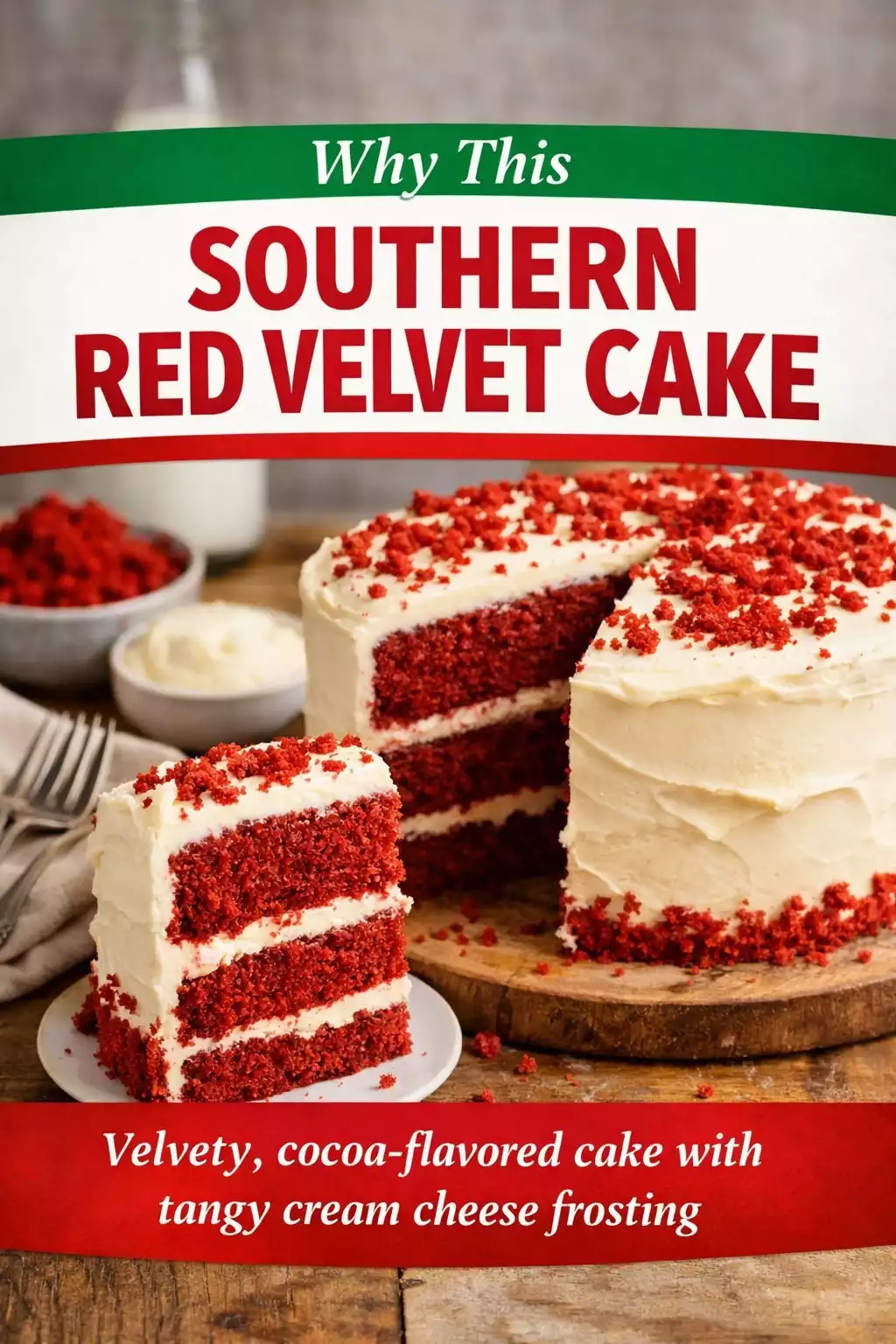
Red velvet cake is one of the most misunderstood cake recipes in American baking. People think the red is the point. It’s not. The color is the signal — the real point is the distinct buttermilk-cocoa flavor, the impossibly tender crumb created by the acid-fat chemistry, and the contrast against tangy cream cheese frosting that makes every bite a complete sensory experience. A Southern Red Velvet Cake done right is one of the most satisfying desserts in the American canon. Done wrong, it’s just a red-tinted chocolate cake with grocery store frosting. Don’t rush this. Good food doesn’t have a timer.
The traditional recipe uses a chemical reaction between buttermilk, vinegar, and baking soda to produce the unique crumb texture. The cocoa amount is small by design — enough for flavor, not enough to dominate. And the cream cheese frosting must be properly made — real butter, full-fat cream cheese, room temperature, sifted sugar. Shortcuts show immediately in the final product. This is a cake that respects its own tradition, and it shows in every slice.
For a full Southern dessert table, pair with hummingbird cake and southern pecan pie. For chocolate lovers at the same table, double chocolate cookies make a natural complement.
Why This Southern Red Velvet Cake Works
- Buttermilk and vinegar — acid tenderizes gluten, creating the distinctively soft, velvety crumb
- Oil-based batter — oil keeps the crumb moist at room temperature longer than butter
- Small cocoa amount — enough for flavor depth without turning this into a chocolate cake
- Red gel food coloring — gel coloring produces vivid color without affecting batter hydration
- Classic cream cheese frosting — the tangy frosting against the mild cocoa cake is the defining balance
Ingredients
The Red Velvet Cake
- 2 1/2 cups (315g) all-purpose flour
- 1 1/2 cups (300g) granulated sugar
- 1 teaspoon baking soda
- 1 teaspoon fine salt
- 1 teaspoon unsweetened cocoa powder
- 1 1/2 cups (300ml) neutral oil (vegetable or canola)
- 1 cup (240ml) buttermilk, room temperature
- 2 large eggs, room temperature
- 2 tablespoons red gel food coloring
- 1 teaspoon white vinegar
- 1 teaspoon pure vanilla extract
Cream Cheese Frosting
- 16 oz (450g) full-fat cream cheese, room temperature
- 1/2 cup (113g) unsalted butter, room temperature
- 4 cups (480g) powdered sugar, sifted
- 2 teaspoons pure vanilla extract
- Pinch of fine salt
How to Make Southern Red Velvet Cake
Step 1: Prep and Preheat
Preheat oven to 350°F. Grease and flour two 9-inch round cake pans, or line with parchment. Using butter to grease and then flouring over it creates the cleanest release for this batter. Have all ingredients at room temperature before starting.
Step 2: Mix Wet and Dry Ingredients Separately
Sift together flour, sugar, baking soda, salt, and cocoa in a large bowl. In a separate bowl, whisk together oil, buttermilk, eggs, red food coloring, vinegar, and vanilla until well combined. The color at this stage will be a deep magenta-red — it lightens slightly during baking.
Step 3: Combine
Add wet ingredients to dry ingredients and stir with a spatula until just combined — no streaks of flour but don’t overmix. The batter will be thin and very red. This is correct. Overmixing develops gluten and makes the cake tough; the goal is tender, so mix only until combined.
Step 4: Bake
Divide batter evenly between prepared pans. Bake for 28-32 minutes until a toothpick inserted in the center comes out clean. The tops will be deep red and set. Cool in pans for 10 minutes before turning out onto wire racks. Cool completely before frosting — at least 1 hour at room temperature or 20 minutes in the refrigerator.
Step 5: Make Frosting and Assemble
Beat cream cheese and butter until completely smooth, about 2-3 minutes. Add sifted powdered sugar gradually on low speed. Add vanilla and salt. Beat on medium until smooth and fluffy. Place one cake layer on a plate or cake board. Spread frosting generously on top. Place second layer. Apply a thin crumb coat to the outside, refrigerate 15-20 minutes, then apply the final coat. For the classic presentation, reserve a small piece of trimmed cake, crumble it finely, and press the crumbs into the top and sides of the frosted cake as decoration.
Tips & Common Mistakes
- Use gel food coloring, not liquid — liquid food coloring requires so much volume to get vivid red that it changes the batter hydration. Gel achieves the color with a fraction of the amount.
- Don’t skip the vinegar — the vinegar reacts with the baking soda and buttermilk to create the signature crumb. It’s not a mistake or typo; it’s essential chemistry.
- Cocoa is a small amount by design — red velvet is not a chocolate cake. The single teaspoon of cocoa adds subtle depth, not chocolate flavor. Don’t increase it.
- Room temperature dairy is essential — cold buttermilk creates an uneven batter. Cold cream cheese creates lumpy frosting.
- The crumb coat is important for this cake — the vivid red crumbs show through white frosting instantly. The crumb coat prevents this.
- Traditional decoration — pressing cake crumbs into the frosting exterior is the classic Southern red velvet presentation. Don’t skip it for the authentic look.
Variations
- Red Velvet Cupcakes: Fill liners 2/3 full. Bake at 350°F for 18-20 minutes. Pipe cream cheese frosting in a high swirl. The vivid red against white frosting is visually striking — a crowd-pleaser at any gathering.
- Red Velvet Sheet Cake: Pour batter into a greased 9×13 pan. Bake at 350°F for 35-40 minutes. Frost in the pan. More casual format, perfect for large groups. Pairs beautifully with no-bake banana pudding at a cookout or potluck.
- Black Velvet: Replace the red coloring with black gel food coloring and increase cocoa to 3 tablespoons. A dramatic, moody variation that works beautifully for Halloween or Gothic-themed celebrations.
- Red Velvet Cheesecake Layer: Add a cheesecake layer between the cake layers. Bake a standard cheesecake layer (without crust) in the same size pan. Stack red velvet, cheesecake, red velvet. Frost with cream cheese frosting. An extraordinary occasion cake.
- Velvet Bundt: Pour batter into a well-greased Bundt pan. Bake at 325°F for 50-60 minutes. Drizzle with cream cheese glaze instead of frosting. Stunning presentation with less assembly effort. See tres leches cake for another showstopper format.
Storage & Make-Ahead
- Refrigerator (frosted): Cream cheese frosting requires refrigeration. Cover loosely and refrigerate up to 5 days.
- Serve at room temperature: Remove frosted cake from refrigerator 30-45 minutes before serving. Cold red velvet cake is denser and less flavorful than at room temperature.
- Cake layers (unfrosted): Wrap in plastic wrap. Refrigerator up to 3 days, freezer up to 3 months.
- Make-ahead: Bake layers 1-2 days ahead and refrigerate wrapped. Make frosting and assemble the day of serving for best presentation.
- Freezing frosted cake: Freeze uncovered until firm, then wrap. Thaw overnight in refrigerator. Some condensation on the frosting surface is normal but cosmetic only.
Frequently Asked Questions
What makes red velvet different from chocolate cake?
The cocoa amount is dramatically smaller in red velvet — this recipe uses 1 teaspoon versus the 3/4 cup you’d find in a chocolate cake. Red velvet is about the buttermilk tang, the oil moisture, and the acid-base chemistry that creates the velvety crumb texture. The chocolate presence is subtle background flavor. It’s a fundamentally different cake concept that happens to use a small amount of cocoa.
Can I make this without red food coloring?
Yes — some bakers use beet powder (2-3 tablespoons) as a natural colorant. The color won’t be as vivid and it varies with oven temperature, but it works. Without any coloring at all, you get a pale brown cake with the same flavor — historically, what the naturally occurring anthocyanins in cocoa produced before Dutch-processing became standard. Still delicious, just not red.
Why does my red velvet cake turn brown during baking?
This is the anthocyanins in the cocoa reacting to oven heat and the alkaline baking soda. Gel food coloring compensates for this, which is why the amount seems large (2 tablespoons). If your cake still turns too brown-red, try adding a splash more vinegar to increase acidity, which helps preserve the red pigments.
My layers are domed in the center — how do I fix this?
Level with a long serrated knife or a cake leveler. Place the cake on a turntable, rest the knife at the height of the lowest edge, and rotate while applying gentle pressure. The dome crumbles from this leveling make excellent cake crumb decoration pressed into the frosting — this is traditional and nothing is wasted.
Can I use sour cream instead of buttermilk?
Thin sour cream with milk to buttermilk consistency (3/4 cup sour cream + 1/4 cup milk) for a workable substitute. Sour cream is thicker and richer, which can make the batter slightly denser. Full buttermilk produces the most authentic crumb texture. See hummingbird cake for another Southern classic worth mastering.